
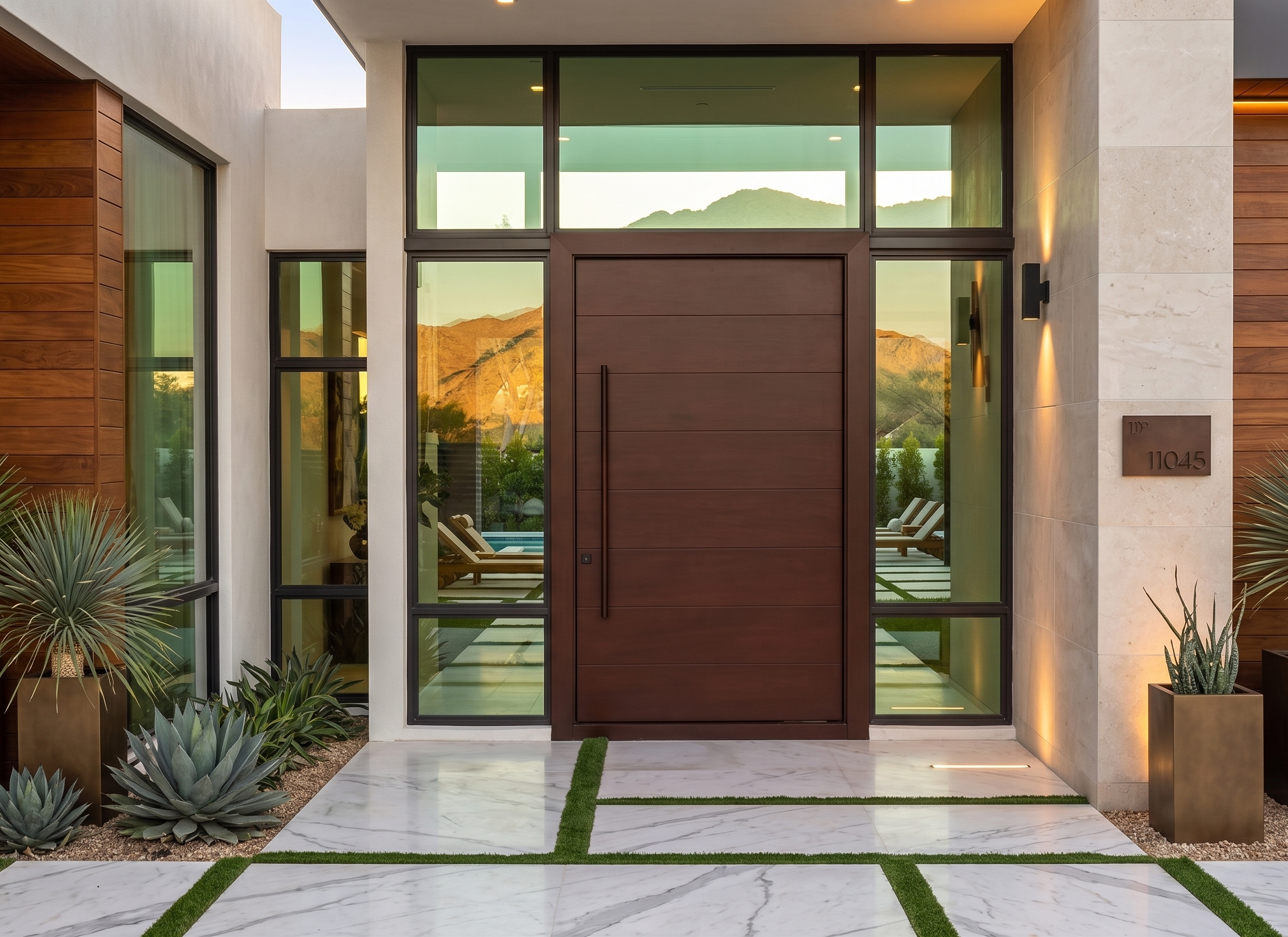
For architects working in South Florida, the entry door is rarely just a design decision. In the High-Velocity Hurricane Zone (HVHZ) that covers Miami-Dade and Broward counties, an exterior door is a tested, certified building component that has to satisfy the building official before it satisfies the client. Specifying the wrong product — or specifying the right product with the wrong documentation — can stall a permit, trigger a redesign, or put a beautiful opening at risk of rejection.
This guide is written for the architect or specifier who needs custom wood entry doors that perform. It covers what our Florida Product Approvals actually certify, the design pressures and sizes you can rely on, what the underlying test protocols mean, and how to write our doors into a spec set cleanly the first time.
Two approvals, two product lines
Our hurricane-impact mahogany doors are covered under two separate Florida Product Approvals, each governing a different configuration. Specifying the correct one for your opening matters. FL#28370 is the approval behind our pivot doors; FL#16326 covers the outswing configurations used for our classical doors, arched doors and church doors.
FL#28370 — Pivot doors. This approval covers our oversized pivot configurations and is the one to reference for large, statement openings.
FL#16326 — Classical (swing) doors. This approval covers our outswing classical wood door line in single and pair configurations.
Both approvals certify solid Honduran mahogany construction tested to High-Velocity Hurricane Zone standards. When you specify, cite the approval number that matches the door type — pivot openings reference FL#28370, classical single or pair openings reference FL#16326.
Certified design pressures and maximum sizes
These are the figures to put in your schedule. They come directly from the current approvals — use them verbatim, and do not round up.
Pivot doors (FL#28370):
- Design Pressure (DP): +65/-65 PSF
- Maximum frame size: 81″ W × 147¾” H
Classical doors (FL#16326):
- Design Pressure (DP): +65/-65 PSF
- Maximum single door: 50½” W × 122½” H
- Maximum pair: 74½” W × 122¾” H
A note worth making explicit for the schedule: both product lines carry the same +65/-65 PSF design pressure rating. The meaningful difference between them is dimensional. The pivot approval permits a substantially taller and wider opening — up to 81″ × 147¾” — which is why it is the right reference for grand, double-height entries. The classical approval governs more traditional proportions in single and pair sets. Choosing between them is a question of scale and architectural language, not of performance rating, since the design pressure is identical.
What TAS 201, 202, and 203 actually test
HVHZ approvals are built on the Miami-Dade Testing Application Standards. If your spec or your building official references them, here is what each protocol verifies — useful context when you need to defend a product selection.
TAS 201 — Large Missile Impact. Simulates windborne debris by firing a length of lumber at the assembly at speed. The door must survive the impact without being penetrated. This is the test that separates genuinely impact-rated assemblies from products that merely look robust.
TAS 202 — Uniform Static Air Pressure. Loads the assembly with static positive and negative pressure to confirm structural performance under sustained wind load. This is where the design pressure rating is established.
TAS 203 — Cyclic Wind Pressure Loading. After the missile impact, the assembly is subjected to thousands of pressure cycles that simulate the prolonged buffeting of a hurricane. The door has to remain intact and sealed through the full cycle count.
Passing all three is what allows a wood door to carry an HVHZ Florida Product Approval rather than a general impact rating. It is also why the certified numbers above are conservative and trustworthy — they represent tested performance, not marketing figures.
Writing our doors into a spec set
A clean specification for one of our doors should reference, at minimum:
- The product line and configuration (pivot, classical single, or classical pair)
- The governing Florida Product Approval number (FL#28370 or FL#16326)
- The design pressure requirement for the opening (our doors are certified to +65/-65 PSF)
- The opening dimensions, confirmed against the certified maximums above
- Material: solid Honduran mahogany
- Finish and hardware, specified separately
Because every door we build is made to order, dimensions, finish, glazing, and hardware are all configurable within the approved envelope. The certified maximums are ceilings, not fixed sizes — most projects fall well within them, and we engineer each door to the specific opening.
Getting documentation for your submittal
For permitting and submittal packages, the underlying Florida Product Approval documentation for both lines is available, and our team can provide the specific NOA paperwork you need to accompany a submission. You can review the approval details for each line on our pivot door approval page and our classical door approval page, and see the broader hurricane-rated lineup on our Florida hurricane doors page.
If your project needs detailed shop drawings, dimensioned details, or finish samples for a specification package, reach out directly — we work with architects and specifiers regularly and can supply what your submittal requires.
A note on scale and design
The reason architects reach for these doors is rarely the certification alone — it is that the certification makes an ambitious opening possible without compromise. An 81″ × 147¾” pivot in solid mahogany is a genuine architectural moment, and the HVHZ approval is what lets it live on a South Florida facade. If you are weighing a dramatic pivot against a more classical proportion for a project, our companion piece on pivot versus swing entry doors walks through the design tradeoffs in plain terms.
Specify with confidence
Every door we make is handcrafted from solid Honduran mahogany at our facility and finished at our Miami workshop, built to the certified envelope of its Florida Product Approval. For architects, that means a custom wood entry door you can detail boldly and submit cleanly.
To discuss a specific opening, request documentation, or get our team involved early in a project, request a consultation or call 561-939-3368. You can also visit our showroom and design center in Miami’s Wynwood district.


